

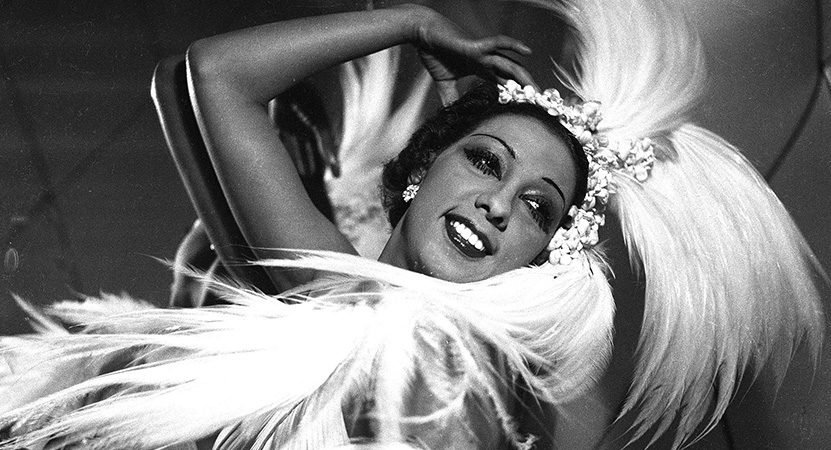



I am Josephine Baker. The day was August twenty-eighth, nineteen sixty-three. I took part in the Civil Rights Movement in Washington D.C. where I proudly wore my French Forces uniform. I've been a French citizen since nineteen thirty-six. I was the only woman to be officially invited to address the audience that had gathered at the National Mall, just before Martin Luther King's "I Have a Dream." I spoke of the Freedom enjoyed in France where public places were not segregated.
I was born in St. Louis. I grew up fatherless and in poverty. Between the ages of eight and ten, I was in and out of school, helping to support my family. As a child, I developed a taste for the flamboyant that was later to make me famous. I later became a dancer, touring at sixteen with a dance troupe from Philadelphia. At nineteen twenty-three, I joined the chorus in a road company performing the musical comedy Shuffle Along and moved to New York City.
By refusing to perform in racially segregated theaters, staying in the finest hotels, and eating in the best restaurants, I wanted to show that skin color did not imply differential treatment and was no obstacle to wealth and fame.
In nineteen fifty-one, in Los Angeles, I had a man arrested because he did not want to "be in the same room as a negro woman." The same year, the NAACP declared May twentyth as "Josephine Baker Day.
My mission was to become a spy for the French Resistance. My diligence was to prove that people could live in relative peace and harmony no matter the color of their skin.
Back to the Civil Rights march in Washington DC, I flew in from France, my adopted homeland, to appear before the largest audience in my career, the twenty-five hundred thousand gathered at the March on Washington. Wearing my uniform of the French Resistance, of which I was active in World War II, I and Daisy Bates were the only women to address the audience.
I spoke just before Dr. Martin Luther King gave his "I Have a Dream" oration. So, I did open my mouth, you know I did scream, and when I demanded what I was supposed to have and what I was entitled to, they still would not give it to me. So then they thought they could smear me, and the best way to do that was to call me a communist.
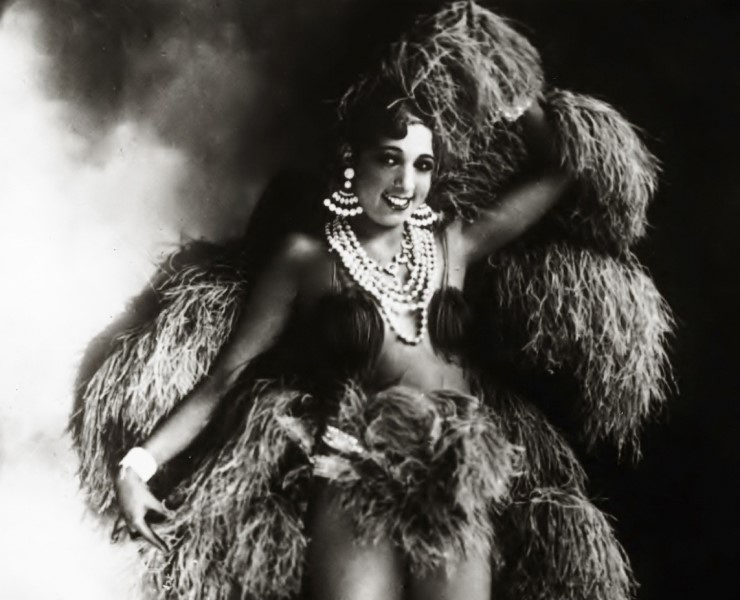
I was remembered by most people as the flamboyant African American entertainer who earned fame and fortune in Paris in the nineteen hundred twenty.
Yet through much of my later life, I became a vocal opponent of segregation and discrimination, often initiating one-woman protests against racial injustice. After the March, I flourished on the European stage and became a successful entertainer who reconceptualized costumes.
My work helped Black entertainers come to be recognized as artists.


:max_bytes(150000):strip_icc()/daniel_hale_williams_2-5c34a4fc46e0fb0001ea908a.jpg)